


-
Academic Article
User Achievement | A New Breakthrough from the Peking University Team: Coherent Raman Reveals the Molecular Basis of Light-Regulated Hypocotyl Elongation

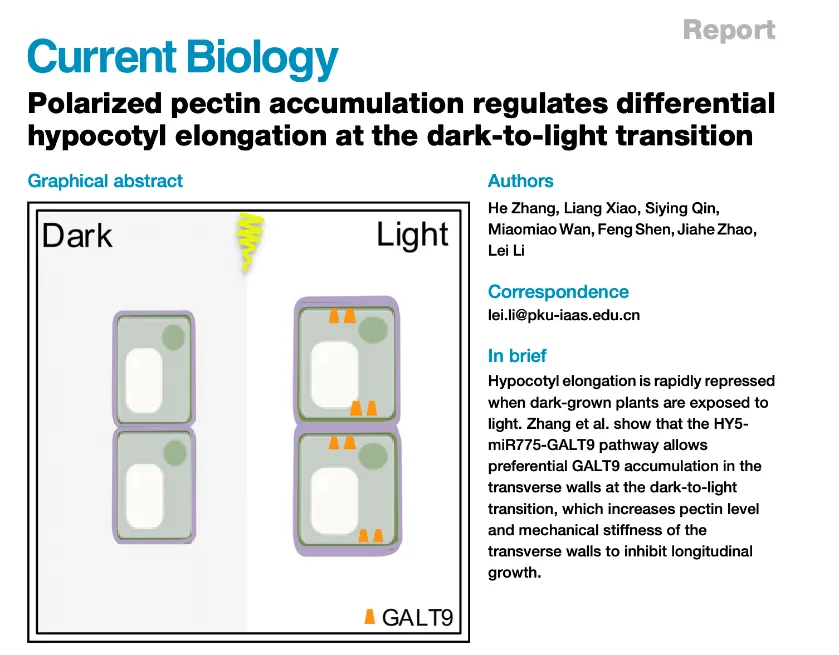
Research Theme and Main Findings
The article summarizes a Current Biology study from the team led by Lei Li at Peking University. The study shows that polarized pectin accumulation in the Arabidopsis cell wall regulates rapid inhibition of hypocotyl elongation during the transition from darkness to light. By combining time- lapse imaging, cell-wall polysaccharide antibodies, coherent Raman microscopy, and atomic force microscopy, the team traced how the HY5-miR775-GALT9 pathway suppresses elongation by strengthening the transverse cell wall.
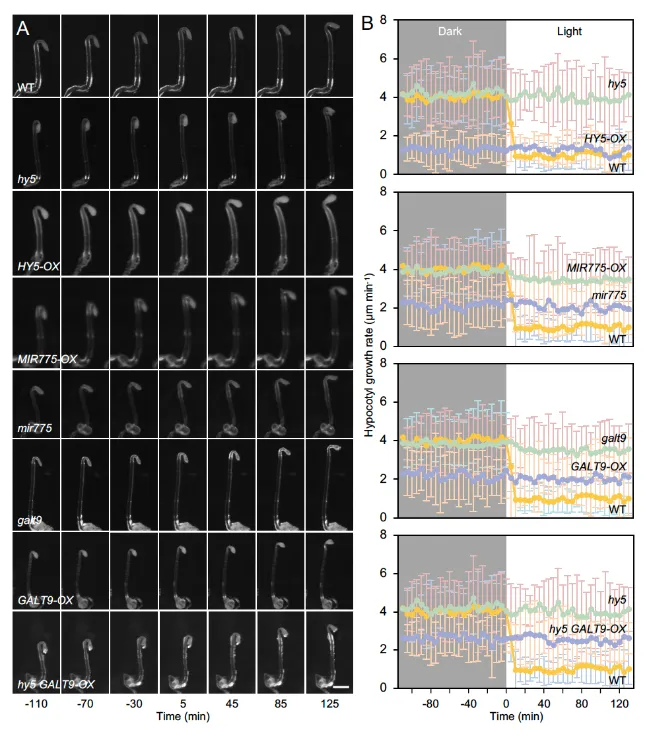
Figure 1: Growth curves of etiolated Arabidopsis seedlings with different genotypes before and after light exposure.
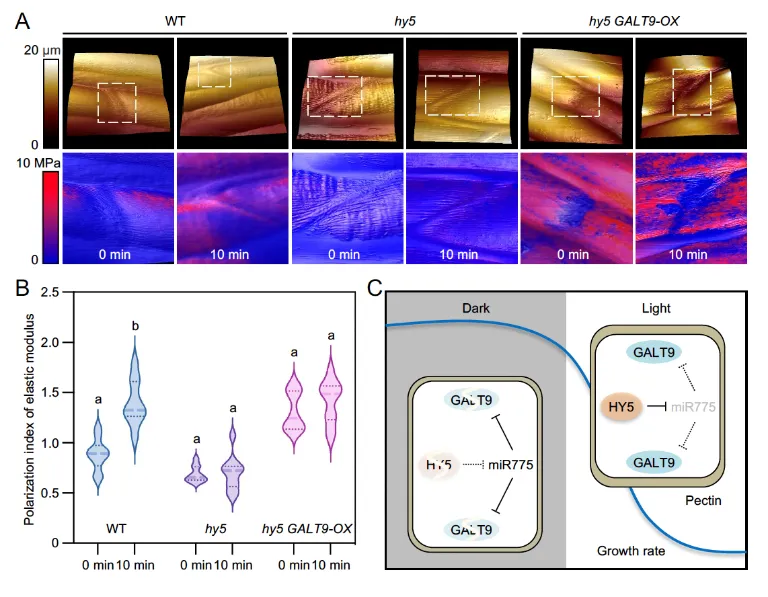
Figure 2: Asymmetric pectin distribution determines cell-wall mechanics and cell elongation.
The Role of Coherent Raman Imaging
The article stresses that coherent Raman microscopy enables chemically specific, in situ imaging of pectin in plant cell walls without labeling. Characteristic Raman shifts around 854 cm^-1 and 1100 cm^-1 are used to track pectin and cellulose, and the imaging results are cross-validated with chemical analysis and immunohistochemistry to strengthen the study's conclusions.
1. Label-Free Detection: Preserves the native state of the sample without exogenous labeling.
2. Chemical Specificity: Distinguishes changes in different cell-wall components during the dark-to- light transition.
3. Three-Dimensional Imaging: Pectin signals can be identified near 845 cm^-1 and compared before and after illumination.
4. Platform Parameters: Up to 350 nm spatial resolution, up to 10 FPS imaging speed, multimodal imaging, and customizable 3D or stitching workflows.
Authors and Source Links
The article identifies Lei Li as the corresponding author and He Zhang as the first author, with additional contributions from multiple Peking University researchers. Vibronix provided coherent Raman imaging and data-analysis support, and the study was supported by the National Natural Science Foundation of China and the Taishan Scholars program.
Source Link 1: https://mp.weixin.qq.com/s/kyAzM0rNqEmM1Qkdh2G9zQ
Source Link 2: https://www.cell.com/current-biology/fulltext/S0960-9822(24)01694-4
Popular Tags
-
Coherent Raman
Recommendation
-
-
Academic Article
2026-02-09User Achievement | The Guizhou University Team Uses Stimulated Raman Imaging to Decipher the Efficiency-Boosting Mechanism of Enzyme Catalysis -
-
-
Academic Article
2026-01-22User Achievement | A New Breakthrough from the Peking University Team: Coherent Raman Reveals the Molecular Basis of Light-Regulated Hypocotyl Elongation -