


-
Academic Article
User Achievement | Coherent Raman Enables Precise Leukemia Subtyping: The H-SRPI Platform Unlocks Subtype-Specific Lipid Metabolism Signatures

Research Background and Core Findings
The article focuses on the clinical need for precise leukemia subtyping. Conventional bone- marrow smear morphology is highly subjective, while earlier Raman approaches were limited by slow throughput, insufficient spatial resolution, and weak scattering efficiency. A team led by Xuelian Cheng and Yuan Zhou at the Institute of Hematology and Blood Diseases Hospital, Chinese Academy of Medical Sciences, reported in Frontiers in Immunology that the H-SRPI platform enabled precise leukemia subtype discrimination and revealed marked differences in lipid metabolism between AML and ALL.
Background: Leukemia subtypes differ significantly, so accurate subtyping directly affects treatment strategy and prognosis.
Finding: The study systematically revealed subtype-specific lipid metabolism heterogeneity and identified leads for metabolism-targeted therapy.
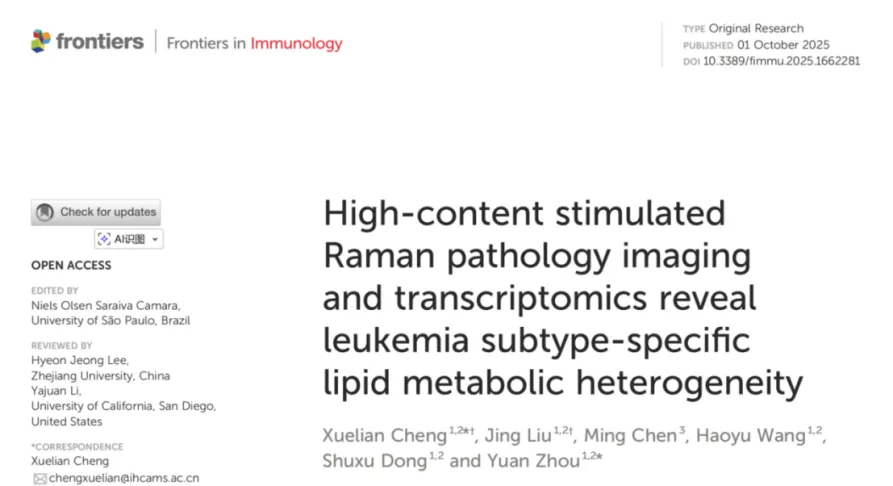
Figure 1. Research outcome
H-SRPI Platform and Technical Breakthroughs
Supported by the core technology of Vibronix's UltraView multimodal nonlinear optical microscope platform, the team developed the High-Content Spectral Raman Pathology Imaging platform, or H-SRPI. It delivers submicron spatial resolution and millisecond time resolution in label-free chemical imaging, allowing researchers to map proteins, nucleic acids, saturated lipids, and unsaturated lipids in single leukemia cells. The study analyzed 324 leukemia cells from 12 patients together with normal hematopoietic cells from 3 healthy donors.
Cross-Disciplinary Expansion: Coherent Raman was extended from pathology studies in other cancers to leukemia research.
Multidimensional Analysis: H-SRPI was integrated with RNA-seq to build a framework combining morphology, biochemical analysis, and gene validation.
Diagnostic Algorithm: Automated subtype discrimination achieved an overall accuracy of 88.21 percent, with certain B-ALL distinctions reaching 100 percent.
Metabolic Targets: The study identified 20 significantly upregulated AML lipid-metabolism genes.
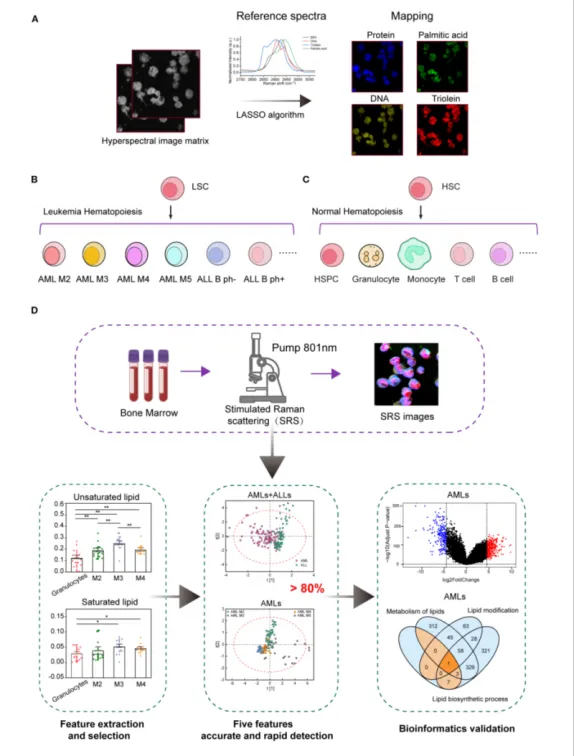
Figure 2. H-SRPI principle and workflow
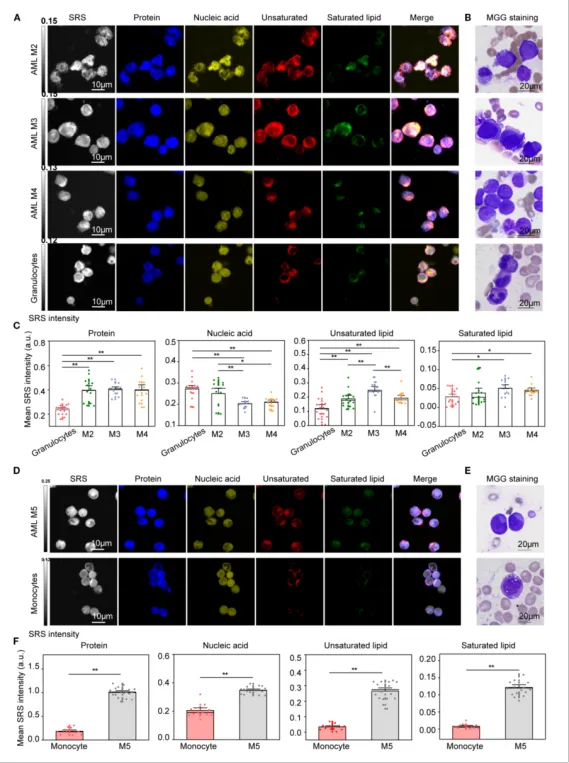
Figure 3. Biochemical comparison of AML and normal cells
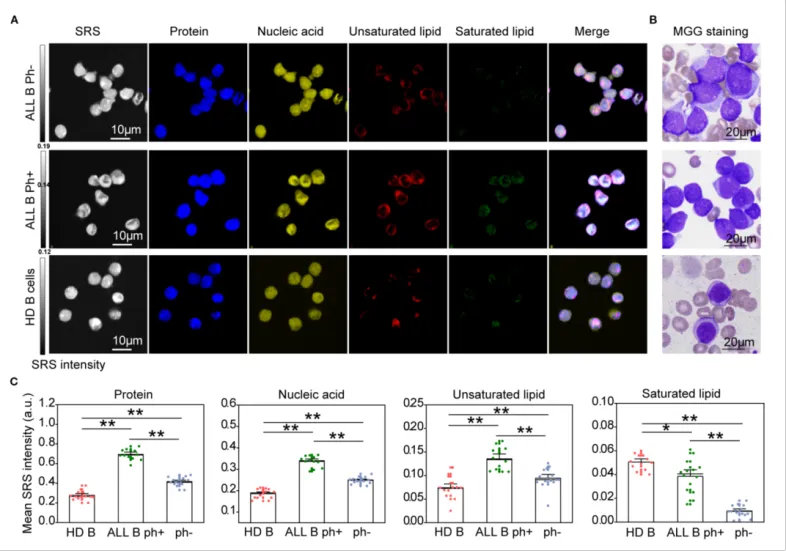
Figure 4. Biochemical comparison of ALL and healthy B cells
UltraView System Characteristics
The article concludes that the UltraView series offers label-free and non-destructive detection, high resolution and high sensitivity, rapid imaging suitable for clinical workflows, integrated morphology-plus-biochemistry analysis, and compatibility with broader research and translational applications.
1. Label-Free and Non-Destructive: Preserves the native biochemical state of cells.
2. High Resolution and High Sensitivity: Maps multiple intracellular components and detects low- abundance enzymes.
3. Fast for Clinical Use: Millisecond-scale imaging supports rapid diagnostic workflows.
4. Integrated Analysis: Combines morphology, biochemical quantification, and algorithm-assisted subtype classification.
5. Expandable Workflow: Can be paired with transcriptomics for both research and translational use.
Reference and Article Navigation
The article cites the 2025 Frontiers in Immunology paper by Xuelian Cheng and colleagues, "High-content stimulated Raman pathology imaging and transcriptomics reveal leukemia subtype- specific lipid metabolic heterogeneity."
Popular Tags
-
Coherent Raman
Recommendation
-
-
Academic Article
2026-02-09User Achievement | The Guizhou University Team Uses Stimulated Raman Imaging to Decipher the Efficiency-Boosting Mechanism of Enzyme Catalysis -
-
-
Academic Article
2026-01-22User Achievement | A New Breakthrough from the Peking University Team: Coherent Raman Reveals the Molecular Basis of Light-Regulated Hypocotyl Elongation -